Microbudget Miracle: Joe Burke for BURT

Updated: Jun 22
Finding the truth in filmmaking...

Few films this year have generated the kind of quiet anticipation surrounding Burt (2026), the latest feature from filmmaker Joe Burke. Blending intimate character work with a striking visual style, the film explores memory, identity, and the fragile ways people hold onto the past. Since its premiere, Burt has sparked conversations for its emotional honesty, understated performances, and Burke’s confident direction — further cementing him as a distinctive voice in contemporary independent cinema.
In this interview, Joe Burke joins us to discuss the inspiration behind the film, the challenges of bringing its world to life, and the creative choices that shaped its tone and storytelling. We’ll also dive into his collaboration with the cast, the themes audiences have connected with most strongly, and what he hopes viewers take away after the credits roll.
What a wonderful film. How did the two of you meet? I’m really interested to hear more about your partnership and what movies mean to you.
Oliver and I grew up together in Toledo, Ohio. He’s the younger brother of my childhood best friend Jason, who I started making movies with when I was a kid. Oliver eventually moved out to Los Angeles after dropping out of Arizona State to pursue acting and comedy, while I was already out in LA after graduating from AFI and trying to get my directing career going.

Partners in crime. Director Joe Burke (right) and co-writer/star Oliver Cooper.
Oliver’s first audition was for the Warner Bros. Hit movie Project X, and once he landed that role, we started making short films together and eventually made our first feature, Four Dogs. Over time, we realized we shared very similar sensibilities, a love for grounded human stories, layered characters, humor mixed with drama, and blending professional actors with real people and non-actors. Movies have always been a huge part of both our lives. It’s how we communicate, process the world, and connect with people. That shared passion naturally evolved into collaborating creatively together.
Burt reminded me of ’90s independent cinema, Jim Jarmusch movies, Shari Springer Berman’s American Splendor, and Alexander Payne’s Nebraska. Were there any specific influences on the writing, acting, or directing?
Alexander Payne is definitely a huge influence on me. Nebraska was certainly an inspiration tonally, and I also really love Sideways. Another massive influence for me is Paul Thomas Anderson, especially Punch-Drunk Love, which is probably my favorite movie of all time.
I’m really drawn to films that balance grounded realism with humor, awkwardness, melancholy, and emotional intensity all at once. Those movies feel human to me. They’re funny, but they’re also heartbreaking and unpredictable. That’s the kind of storytelling I’ve always gravitated toward as a writer and director. I love stories about flawed people trying their best, navigating loneliness, dreams, failure, connection — all those messy things that make life interesting.

Playing himself. Oliver Cooper (left) as Sammy and Burton Berger as 'Burt'.
The film has been described as a love letter to both Burt Berger and your father, who also lives with Parkinson’s. How did that personal connection shape your directing choices?
Burt became a very important person in my life over the years. I originally met him while he was playing music at a restaurant near Malibu, and Oliver knew him separately through open mics and comedy nights. We cast him in our short film Another Cancer Movie back in 2018, and after that I spent the next several years getting to know him and hearing his life story.
“I knew from the beginning that I didn’t want to hide Burt’s Parkinson’s or work around it. I wanted it to simply exist naturally as part of who he is.”
— Joe Burke
Around that same time, Burt was officially diagnosed with Parkinson’s — right around when my dad was also diagnosed. What made it even more surreal is that Burt and my dad are the exact same age. Eventually I moved in with my dad in West LA to help him out and save money, and during that period I decided to finally make my second feature film, Burt. So, I was literally living with my father, helping care for someone with Parkinson’s, while making a father-son movie centered around another man living with Parkinson’s. It was an incredibly personal and emotional experience.
I knew from the beginning that I didn’t want to hide Burt’s Parkinson’s or work around it. I wanted it to simply exist naturally as part of who he is. That honesty became the emotional backbone of the film.

Chillin' out. Sammy takes a breather.
There is a blurred line between fiction and reality that you both manage to do so well by centering on the personality and music of Burt. What first convinced you there was a film worth building around him?
What drew us to Burt was his spirit. He’s one of those rare people who just keeps going no matter what life throws at him. He’s incredibly optimistic, funny, soulful, and authentic. We always talked about how we should cast him in something one day.
When we made Another Cancer Movie, we gave him a fun role as a sound guy, and he was just magnetic on screen. Completely natural. Funny without trying. Totally himself. After that, I spent the next few years hanging out with him, hearing stories about moving to LA in 1974 to pursue music, never really “making it,” but continuing to play music and chase his dream anyway.
There was something incredibly moving about that to me. Burt, Oliver, and I are all dreamers in our own ways. I felt strongly that Burt’s music, personality, and soul deserved to be captured on film. It honestly felt less like “creating a character” and more like documenting someone special before the world passed him by.
I can’t get over the budget — $7,000 and shot in seven days?! I’d love to hear how you made this work so well. What were the creative limitations? Did they become unexpected strengths?
After Four Dogs, I spent years trying to get bigger projects off the ground. I wrote scripts, had close calls, pitched TV shows, met with actors — but nothing quite happened. Eventually I reached a point in my late 30s where I just knew I needed to stop waiting around and make another feature no matter what.
“We had no choice but to stay focused on performance, emotion, spontaneity, and truth.”
— Joe Burke
Oliver told me he had access to about $7,000 from family, friends, and his own savings, and he asked if we could make it work. I immediately said yes. Then he asked how many days we’d need, and I just said, “seven days.”
About two months later we were shooting the movie.
We borrowed two cameras from two different friends, had a three-person crew, minimal lighting, almost no equipment, and just leaned fully into what we had available. But honestly, those limitations became strengths. We had no choice but to stay focused on performance, emotion, spontaneity, and truth. We were prepared, but we also left room for accidents and unexpected moments to happen. That openness allowed a lot of movie magic to sneak into the film.

In it for the money. Catlin Adams as the scheming Sylvia.
What advice do you have for upcoming filmmakers attempting to make a film with similar micro budgets?
The biggest advice I can give is: learn how to edit your own movies. Editing teaches you how to think like a filmmaker. On a micro-budget, you don’t have the luxury of shooting endless coverage or wasting time figuring it out later. You need to know exactly what you need.
Because I edit my own work, I was able to direct and shoot Burt with an editor’s mindset the entire time. That helped tremendously. Once we had a rough cut finished, we used it to raise finishing funds for music, sound design, and post-production.
I also always tell my students to write around what they already have access to. Locations are everything on a low-budget movie. If you have access to a house, an apartment, a restaurant, a friend’s business — start there and build stories around those spaces. Having control over your locations and environment allows you to do so much more with very little money.
Sammy walks a fine line between opportunistic, funny, and emotionally vulnerable. How did you approach making him authentic without appearing unsympathetic?
Oliver did an incredible amount of work figuring out Sammy’s backstory and emotional reality. We talked endlessly about who this guy was and why he makes the choices he makes. I’ve always believed that even characters who make bad decisions still need to feel human. Nobody wakes up thinking they’re the villain. Everyone has reasons, fears, insecurities, regrets, desperation. I wanted Sammy to feel flawed and messy, but still understandable.
If you approach characters with empathy instead of judgment, I think audiences can connect with them even when they’re making questionable choices. That human complexity was very important to us.
The black-and-white cinematography gives Burt a timeless, documentary-like intimacy. Why did you feel monochrome was the right visual language?
We did an early test shoot at Burt and Steve’s house that I shot myself. Later, Oliver suggested we try watching the footage in black and white just to see what it felt like. The second we did, we knew there was no going back.
Everything suddenly clicked. Burt and Steve’s faces looked incredible. The house felt timeless. It gave the movie this intimacy and honesty that immediately felt right for the story we were telling.
It also helped us practically on a micro-budget level because black-and-white can be very forgiving with lighting and production design limitations. But ultimately, it just emotionally felt correct. It gave the film the exact tone we were searching for.
As mentioned, you previously collaborated on Four Dogs (2013). How has your creative partnership evolved since that earlier film?
I think Oliver and I have both grown tremendously as writers, producers, and collaborators since Four Dogs. Back then we were younger and still figuring out our voices. Over the years we’ve really developed a creative shorthand with each other.
We understand each other’s strengths now. Oliver has instincts and strengths that I don’t have, and vice versa. We’ve learned how to trust each other and fall into our roles naturally. There’s less ego and more collaboration now. We’re both ultimately chasing the same thing emotionally and creatively, and I think Burt reflects how much stronger that partnership has become.
Much of the dialogue and chemistry in Burt feels spontaneous. How much was scripted versus discovered organically on set?
It was really a mix of both. We had an extremely detailed outline and knew all the emotional beats and structure of the movie, but we also intentionally left room for spontaneity and discovery.
Burt and Steve are such naturally authentic people that sometimes the best thing you can do is simply let them exist on camera. We would often let scenes breathe and allow improvisation around the framework we had built. Some moments were scripted very specifically, while others evolved naturally through conversation and energy on set.
That balance between preparation and openness became a huge part of the film’s identity. Burt and Steve never saw the outline we wrote. That was just for me, Oliver, and our DP Daniel Kenji Levin.
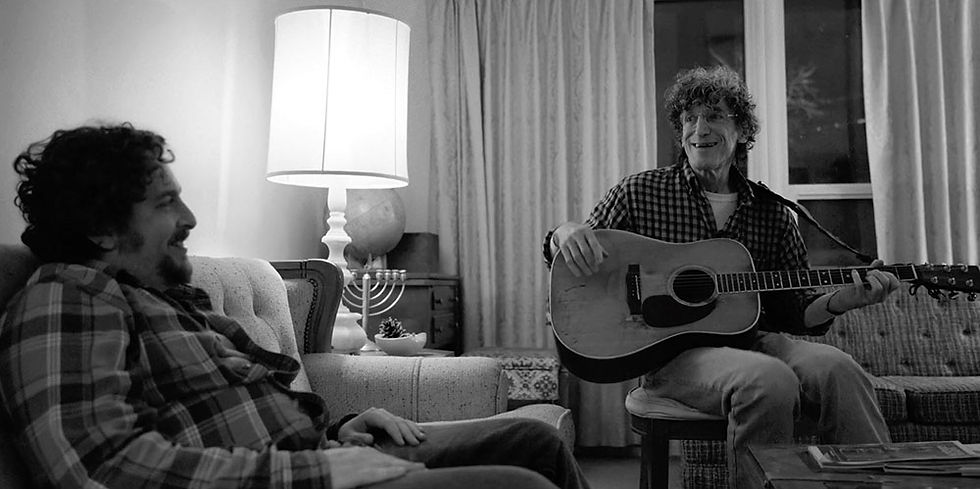
Musical interludes. Burt's songs are an integral and soulful part of the film.
Music plays such a central emotional role in the film. How did Burt’s real songs influence the structure and tone of the screenplay?
Burt’s music was one of the biggest inspirations for the entire movie. There’s a song he performs near the end of the film called “Improvin’ On” that I first heard years ago from an old YouTube video of him playing at an open mic. We used that song at the end of our short film Another Cancer Movie, and I listened to it constantly for years afterward.
That song honestly became the emotional anthem of this project for me. I kept thinking, “the world needs to hear this guy’s music.”
Even when Burt would come over to my apartment every few months, he’d bring his guitar and play me new songs. During COVID he wrote a song called “Freedom,” which eventually became the opening song of Burt. His music wasn’t just background texture, it genuinely shaped the emotional structure and soul of the movie.
Independent films often struggle balancing humor with serious themes like illness, loneliness, and regret. How did you avoid becoming overly sentimental?
That balance is honestly my favorite kind of storytelling. Since I was a teenager making movies, and later in film school in Chicago and at AFI, I’ve always gravitated toward character-driven dramedies that mix humor and heartbreak together.
To me, the key is honesty. If you play scenes truthfully and don’t force sentimentality, humor and emotion naturally coexist. Life is awkward and emotional at the same time. I never wanted Burt to feel manipulative or overly sentimental. I wanted it to feel human. And I think when you approach material from that honest emotional place, audiences can really connect with it deeply.
Banding together. Cast and crew (left) during filming and Burt Berger with Joe, Oliver and co-star Steven Levy who also plays a version of himself.
After the festival response and critical praise for the film, what do you hope audiences take away from the relationship between Burt and Sammy?
I hope audiences take away the importance of empathy, forgiveness, and truly seeing people beyond their mistakes or circumstances.
We live in a world right now where there’s so much judgment and finger-pointing. People rarely slow down long enough to understand why someone may be struggling or making bad decisions. Burt’s character sees Sammy as a human being first. He sees beyond the surface.
Even though Sammy enters Burt’s life under questionable circumstances, Burt recognizes something good in him. I think that curiosity and compassion are really important. I hope audiences walk away remembering that everyone is carrying something, everyone has struggles, and sometimes connection can come from the most unexpected places.
You can find out more on Burt via the official site BurtTheMovie.com. The film is on VOD, Apple and Amazon from June 16th.


Comments