Familiar Demons: Natasha Kermani for THE DREADFUL

Updated: Feb 21
One dark knight…
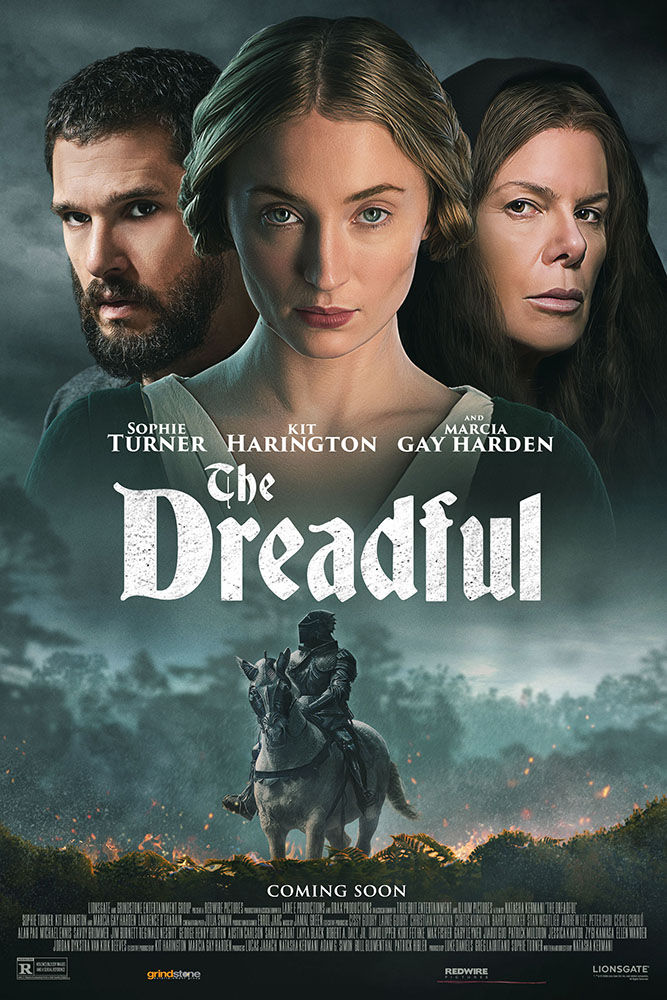
Following last year’s adaptation of Joe Hill’s novel Abraham’s Boys, Natasha Kermani has continued to carve out a space for delving into psychological period pieces. With her latest film, The Dreadful, she continues to explore fear not as spectacle alone, but as something deeply embedded in identity, power, and perspective. Kermani’s work resists easy categorization — melding arthouse sensibilities with visceral suspense — and invites audiences to sit with discomfort… rather than escape it.
In this interview, Kermani discusses the inspirations behind The Dreadful, location, collaboration, and how she crafted an atmosphere that lingers long after the credits roll.
For those who don’t know, The Dreadful draws inspiration from the same ancient Shin Buddhist parables that Kaneto Shindō’s 1964 Japanese classic Onibaba was also based on. What drew you to this particular folklore as the source material?
The core of it for me was the idea of centering the story around two women living together in isolation, in a co-dependent relationship. And then exploring what happens when that relationship starts to fray and be pulled apart. Everything else from the story — including the genre elements, the mythology, and everything that comes into play — spins out from that initial core image of the two women co-existing in this very desolate, stark, isolated landscape.

I’m interested to hear how you settled on the historical setting of the Wars of the Roses and what you felt it would bring to a supernatural and psychological horror.
I always knew I wanted a medieval setting, but I chose this 15th-century time period because it felt like a time of transition, or at least on the precipice of change. It’s the last gasp of the dark ages, with a new era right around the corner; Queen Elizabeth, Shakespeare, the split of the Church of England and the Catholic Church… big shifts in societal, cultural, and philosophical thought. For me, that felt like a really interesting time that we don’t see onscreen that often (the exception, I suppose, being Game of Thrones!), and it felt perfect for a story about someone navigating dark times and seeking out the light.
Were there particular challenges or freedoms you found shooting in a period setting of 15th-century England?
One interesting aspect actually had to do with the language and accent that the characters use in the film. I had a version of the script that was completely period-accurate 15th-century “Old English”, but it just didn’t feel accessible. But having a totally modern English or Cornish accent also didn’t feel quite right. We ended up working with a historian named Simon Roper to create a totally unique dialect that fit into the world we were trying to build. Luckily, he was even able to be on set with us for most of the shoot as a sort of dialect coach!

Kermani with with Sophie Turner on set in Cornwall for THE DREADFUL.
Were there any cinematic influences? If so, what did you draw on to craft the Gothic tone and look of the film?
Justin Kurzel’s Macbeth from 2015 was a really big visual reference for us, shot by one of our favorite DPs, Adam Arkapaw. Tonally, we also talked a lot about Bergman’s The Seventh Seal, and discussed approaching the cinematography almost in terms of a high contrast black and white film, but then of course integrating all of our color story into the image. Story-wise, I thought a lot about films that have limited scope but a lot of intimate “life,” like Ben Wheatley’s A Field in England or Robert Eggers’ The Witch. Of course, we wanted to have some visual nods to Onibaba, as well, especially in how we photographed the two women.
“It’s the last gasp of the dark ages, with a new era right around the corner; Queen Elizabeth, Shakespeare, the split of the Church of England and the Catholic Church…”
— Natasha Kermani
Were there horror films or directors that you specifically wanted to nod to or avoid echoing?
We definitely wanted our film to feel distinct from recent period horror/fantasy films like The Witch or The Green Knight, which are both beautiful and incredible films, but tonally feel very close — so we wanted to feel distinct. Life, we had our own “vibe” so to speak. I wanted our suit of armor — which has tones of the legend of the Green Knight — to feel very different from David Lowry’s design, and so we really pushed to create a suit of armor that felt gothic; very much made of metal and steel and leather, and a helmet that had a really unique, almost amphibious feel to it. In terms of costuming and world-building, we wanted to make sure we were avoiding the feel of Game of Thrones. Kit Harington had the idea to cut his hair short, for example, to feel really distinct from the long-haired Jon Snow look. We’re playing in a similar sandbox of dark fantasy set in that medieval period, but I think we were able to lean a bit more towards a folkloric feel and away from the high-fantasy feel of GOT.
Your film explores power, fear, desire, and survival in an isolated community — what emotional undercurrents were most important for you to bring to the forefront?
I think the most important thing for me was starting from this place of co-dependency, the relationship between these two women, and how that relationship starts to fray at the edges after they receive the bad news about Seamus. I wanted to understand and empathize with both of these women, and not necessarily paint one as good and one as evil. Both these women are trying to move forward as best they can, but their paths seem to be splitting.
I am assuming Kit Harington came onboard via Sophie’s recommendation, given their shared Game of Thrones history? How did this new dynamic work for them?
Kit and Sophie’s shared history from their time together on GOT ended up being a really beautiful parallel for the two characters’ past. The dynamic of childhood friends who have now grown up feels very intimate and very real in the film because of their real-life dynamic. That was a really great aspect of filming their scenes together, and made a huge difference, especially because we had such limited time and resources on this film! They were able to walk right onto set and immediately inhabit that aspect of their relationship.
Game of Thrones alumni Sophie Turner and Kit Harington star alongside a menacing Marcia Gay Harden.
Marcia Gay Harden always delivers a unique menace. How did you approach directing her in the role of Morwen? I’m fascinated to hear about her process and what she brought to that character.
Marcia is, of course, an enormous talent and hugely accomplished. Most of our prep really revolved around finding Morwen’s emotional throughline — her fear of being alone — and making sure that emotional truth was present with every scene and every action she takes.
Julia Swain’s cinematography is beautiful. What did you both set out to achieve in terms of the look of the film?
We really wanted a painterly, anamorphic frame that really emphasized the landscapes and environments. As with all our projects, we wanted to play around with our use of color, and with this film, we created a few distinct looks that are used throughout the film to represent different points of view and timelines. We worked with Panavision anamorphic T-series lenses and one specialty spherical “Portrait” lens that has this really interesting blending effect along the edges for special moments, to evoke a more dreamlike quality.
“… it was very much a dance with the realities of being out in the elements!”
— Natasha Kermani
In terms of location, what unique challenges did filming in Cornwall present, and how did that environment influence the visuals beyond the script?
Filming The Dreadful on location in Cornwall in the winter was sort of wild for my team and I because we had just come off a summer shoot in California which was very sun-soaked, dusty, and extremely hot temperatures — so to be suddenly transported to a completely different environment was great and we were able to draw a lot of inspiration from the setting of coastal England, itself. Lots of natural mist and fog, rainy afternoons, and fall foliage.
Since everything was filmed on real locations, we really tried to step back and have a more naturalistic approach, to let this very unique environment feel almost like a character in the film. And of course, the difficult logistics of that location very much affected choices for production design and shot design. Working with limited resources in that environment meant we had to be very precise and specific with how we were building and photographing sets.
Some of my favorite locations that we scouted were simply too difficult to access with equipment and crews! The hut, for example, we ended up building near an access road, with one wall that could be removed and flooring to help with mud coming through the ground. So, it was very much a dance with the realities of being out in the elements!
What reactions (or emotions) do you hope audiences walk away with after watching The Dreadful?
I hope that this film feels like a dark fairy tale, that it can take audiences on a journey to a place that feels a bit magical, a bit mystical, a bit dangerous. And I always love if there’s some space for conversation after the film is over — ie, what do you think happens next?
You can follow Natasha Kermani on Instagram. The Dreadful is released in US theaters and On Demand this Friday, February 20th.


Comments