A Delicate Touch: Adam Rifkin for LAST TRAIN TO FORTUNE

Is the book mightier than the gun?
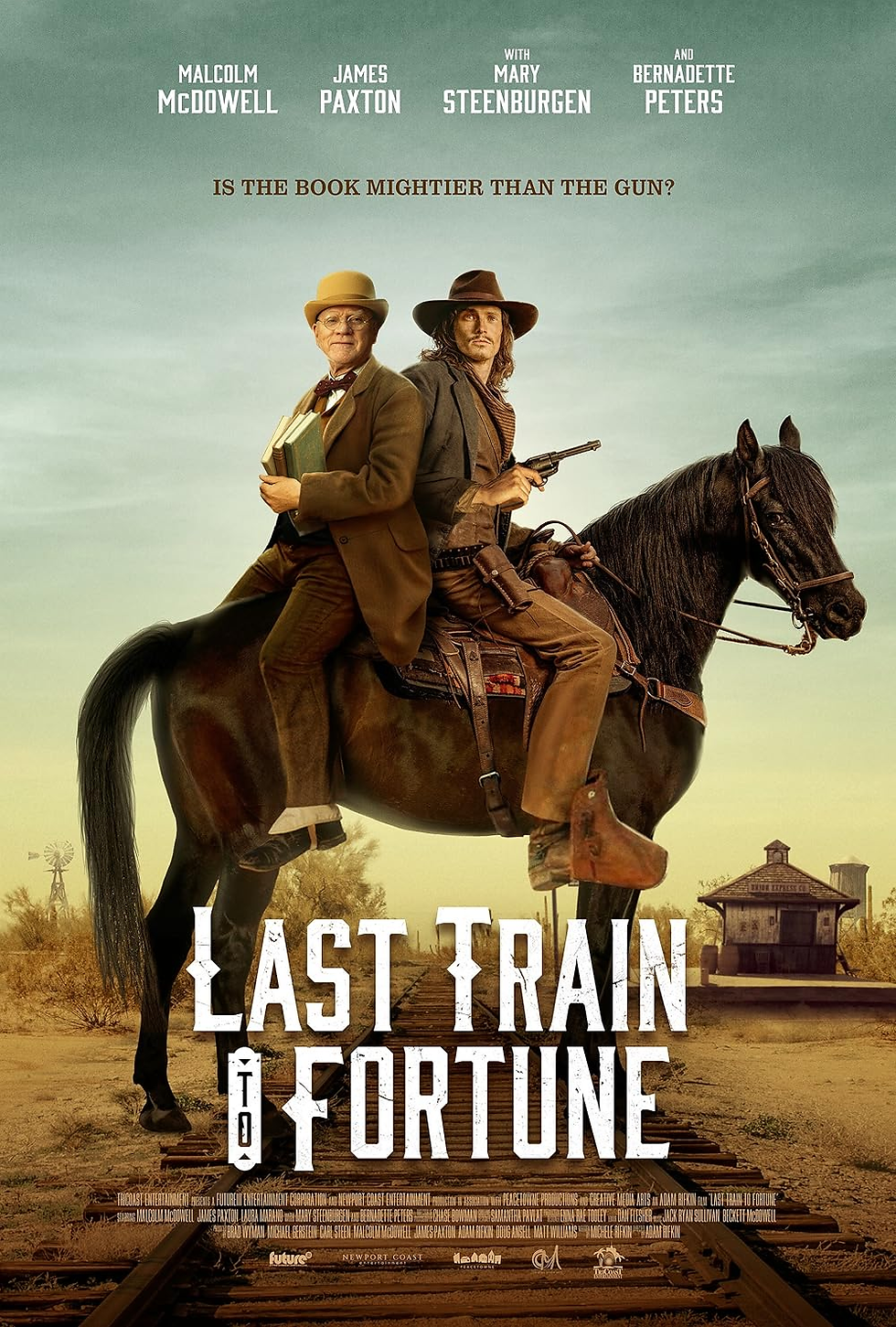
Writer/director Adam Rifkin has built a career on fearless genre-blending tales laced with fun and sharp wit. If you’ve seen Gore Verbinski’s Mousehunt (1997) and Joe Dante’s Small Soldiers (1998), you’ll certainly have had a good time with those movies. For his latest venture, Last Train to Fortune, the journey is deeply personal. Decades in the making, the heartfelt western began as a screenplay written by his mother in the 1980s, with Lindsay Anderson set to direct, along with Malcolm McDowell and Bill Paxton to star as the leads. With the original project falling through, Rifkin has finally brought his mother’s words to the screen, honouring not only her love of education and the Old West but the teachers who inspired her life’s work.
Last Train to Fortune carries generational echoes both on and off screen, from the casting to the music to its thematic heart. This is a story anchored by a commanding turn from Malcolm McDowell, who stuck with the script all these years; the film exploring mentorship, redemption, and the quiet power of belief. In this first conversation, Rifkin reflects on legacy, loss, creative restraint, and fulfilling a promise…
What is your history with coming on board Last Train to Fortune?
My history with the film dates back to the very beginning. I had been living in Los Angeles for about a year and was going to film school. I dropped out and started writing movies for myself to direct. Not long after, my mother and my sister moved West to join me. My mother had been writing for local television and theater in Chicago, so she made the move to LA to pursue her own dreams of screenwriting. We all moved in together, and one of the first things she wrote was Last Train to Fortune. At that moment in time, PBS was hosting a screenwriting contest called “The Great American Western Screenplay Competition”. The winner would have their script produced for Public Television. My mother wrote the movie specifically for the contest, and as it turns out, she won. But they told her that it would be too expensive to produce, so she had the bragging rights, but the script remained unmade. But I was there every day watching her write it, so I guess you could say my history started prior to page one.

Writer/Director Adam Rifkin.
There appears to be such a family legacy/connection amongst you all…
Yes, the film is a family affair from top to bottom. My mother wrote the script. Bill Paxton originally was slated to play Dooley, and, as you know, his son James Paxton stepped in to fill those shoes. Malcolm McDowell’s son scored the picture, performed, and wrote the original songs. Two of his other sons appear in the film. My nephew wrote the novelization of the film, and my other nephew acted in it. There are even more familial connections than that, but those are the highlights.
I’m interested to hear what kind of shape the original incarnation of the film with Lindsay Anderson and Bill Paxton was in. Did you start from the ground up with your mum’s script, or is it pretty much intact?
The script has never changed. From the day my mother submitted it to PBS to the day we finished shooting it. Sure, there are tweaks that have to be made for production along the way. Little technical things like location changes based on availability, but the movie you watched is the script my mother wrote back in 1986.
What experience did your mum have writing the script for Last Train to Fortune?
My mother loved writing the script because it brought together her two passions: Education and the Old West. Growing up, my mother dreamed about being a cowgirl. Back in the 1950s in America, westerns dominated film and television. She grew up enamored with that spirit of frontier living. She also became a teacher because of her lifelong passion for reading and learning. When she sat down to write the screenplay, she decided to combine her two loves into one work.
“It’s about how important teachers are and how good teachers inspire us all.”
— Adam Rifkin
There is something so relatable to the characters. Were any story beats inspired by real-life people or events, or is the script simply tapping into those universal themes?
Generally, she wanted to tap into those universal characters and themes, but much of the story’s philosophy was directly inspired by teachers from her own past. Educators who had inspired her throughout her life. She passed down those sentiments to her students, as well as to me and my sister. I would hate to speak for her, but I know from our discussions that much of what Cecil has to say came from some of the teachers she learned from. My sister has grown up to be a teacher as well, by the way. And a writer.

Reading the road ahead. Dooley (James Paxton) and Cecil Peachtree (Malcolm McDowell) in LAST TRAIN TO FORTUNE.
Oh, that is wonderful to hear. There is such a lineage even off the page and screen. Blending genres, how did you strike the tone you wanted?
I have always been a believer in genre blending. Just because a movie is a drama doesn’t mean the characters can’t be funny. Or situations can’t be funny. In fact, I would argue that if you can laugh with a character, it’s much easier to cry with them.
For sure. Your work often mixes humour with sincerity.
Life is a mixed bag of emotions. If movies are supposed to reflect life, humor and sincerity are both a part of that emotional mix. Most of my favorite films juggle elements from multiple genres simultaneously.
What were the biggest creative conversations you had with your cast during filming, especially in helping retain the spirit of the original project, along with Lindsay and Bill’s legacy?
Believe it or not, we didn’t need to have big creative conversations to help keep the spirit of the original project alive. The script was our Northstar. Everybody loved the material from the beginning and followed the words and the sentiments within. The same held true when Bill originally was going to play Dooley, and when Lindsey was originally going to direct. Be true to the words, and the rest will fall into place.
You must have felt a huge amount of pressure. What helped ease this, especially filming a Western out in the elements?
The only pressure I felt was the pressure to please my mother. I wanted her to be happy with the end result. I wanted her to feel her script was treated with the respect it deserved. Luckily, my mother did get to see the final film before she passed.
I’m sorry to hear about your mother — that is genuinely heartwarming, though to know she watched her story brought to life before she passed.
She couldn’t come to the premiere because she was bedridden, but she watched it on her iPad, and she loved it. That’s all that matters to me.
Western reunion. Left: McDowell reteams with Mary Steenburgen. Right: Dooley and Cecil trade with a native.
I’m interested to hear how the look and visual language of the film evolved through pre-production, especially with such an economic approach.
The Director of Photography, Chase Bowman, and I wanted the film to have a classic look. We shot anamorphic so we could really drink in the landscapes. We wanted the lighting and the colors to be rich and well-textured. Like worn-in leather. Westerns generally have two styles: the American western look, which is bold and colorful and romanticizes the Old West, and the spaghetti westerns, which had a darker, grittier look and feel. We didn’t really want to emulate either one. Even though we had a modest budget and an accelerated schedule, we still tried our best to give the movie a visual elegance that usually comes with bigger films.
Malcolm McDowell feels like a fulcrum and the connective tissue here. What else did he bring to the production other than having lived with the project so long?
Malcolm McDowell is one of the greatest actors who has ever lived. When you work with Malcolm, he brings the gravitas and swagger of an artist who has been at the top of his game for 60 years. He’s seen it all, he’s done it all, and he’s been in every type of movie and has worked with a rogues gallery of the greatest filmmakers who have ever lived. When he walks onto a set, he brings that storied history with him. It just follows him wherever he goes. A close-up of Malcolm McDowell’s face is all the production value any movie ever needs.
As an educator myself, I specifically loved the relationship between the teacher and dispossessed youth. Cecil Peachtree and his passion for learning and unlocking the “little door deep within us all that gives us permission to dream” is a wonderful thing to behold, as it chips away at Dooley, slowly but surely. Is this the true heart of the story, and, if so, what do you feel this was originally born out of?
That speech that Malcolm gives is exactly what this movie is about. It’s about how important teachers are and how good teachers inspire us all. So yes, that is the heart of the story. As mentioned, what was originally born out of was my mother’s love for the teachers who inspired her, and then her love of teaching going forward in her own life. Inspiring young minds was her greatest passion.
Was there a particularly challenging or surprising day on set that stands out?
I would humbly say every day was challenging. But not surprising. We knew going into this movie how difficult it was going to be. And true to our expectations, it was a tough shoot. Shooting in the elements always is. We happened to shoot during a particular rainy season in Los Angeles, which, as you know, is quite rare, so we were often forced to have a shut down for two days here or three days there to wait for the rain. On most movies, you have cover sets, which are interior locations on standby in case of rain. Because 80% of this movie is set outside during the day, sometimes we just had to go dark while we waited for the rain to stop.
I loved the use of circles as editing devices — windpump to sun to watch — and also even a nod to Edwin S. Porter (maybe). How has your directorial style evolved in new ways through this project?
Each film is its own beast. With its own language and its own iconography. I wanted to be understated with Fortune. I wanted to direct it with a gentle hand. But that said, you find little flourishes along the way to give it some panache. Little motifs here and there — having a good eye!
What did the experience teach you as a filmmaker that you’ll carry into your next work?
Wear boots when working with horses. Sneakers and horse shit are a bad combination.
[Laughs] If you could speak to your younger self — the one making early independent films and writing — what would you say about taking on this project?
During that time in my life was exactly when Fortune almost got made the first time. I was young and hungry and trying to make outrageous indie films to draw attention to myself. When Mr. Anderson attached himself to direct the film, I was ecstatic. I was such a big fan of his work. We all had lunch together, my Mother, Malcolm, Lindsay, Producer Brad Wyman, and me. Listening to Lindsay talk about American westerns — particularly John Ford films — was fascinating. He was a huge Ford fan and even wrote a book about him. At that lunch, he talked about wanting to direct Fortune with a delicate touch. I remember that specifically. So, in taking on the project, I just followed Lindsay’s sage advice of that delicate touch.
Before we wrap up… I have to point out the Time After Time reunion!
Watching Malcolm and Mary together was truly magical to see. First of all, they have a fantastic relationship. They’re all one big happy family. They may not be married anymore, but both of their families are close to one another’s. So that fondness and family love are ever present. But watching them perform together was just beautiful. Afterwards, Malcolm told me he loved working with Mary again. He said it was like “walking back in time.” Very applicable, wouldn’t you say?
That is super special to hear! What emotional experience do you want audiences to walk away with after watching Last Train to Fortune?
The most important thing to my mother, as a teacher, was making a difference in the lives of her students. Even if she could only make a difference to one student, it would all be worth it. By the end of the movie, without giving anything away, we see Cecil has made a difference in somebody’s life. I want that to land. I want that realization to be meaningful to the audience, as it is to Cecil.
You can follow Adam on Instagram. Last Train to Fortune is in theatres this Friday September 22nd, streaming and on demand.


Comments