A Timeless Story: James Paxton for Last Train to Fortune

The young and the Old West…
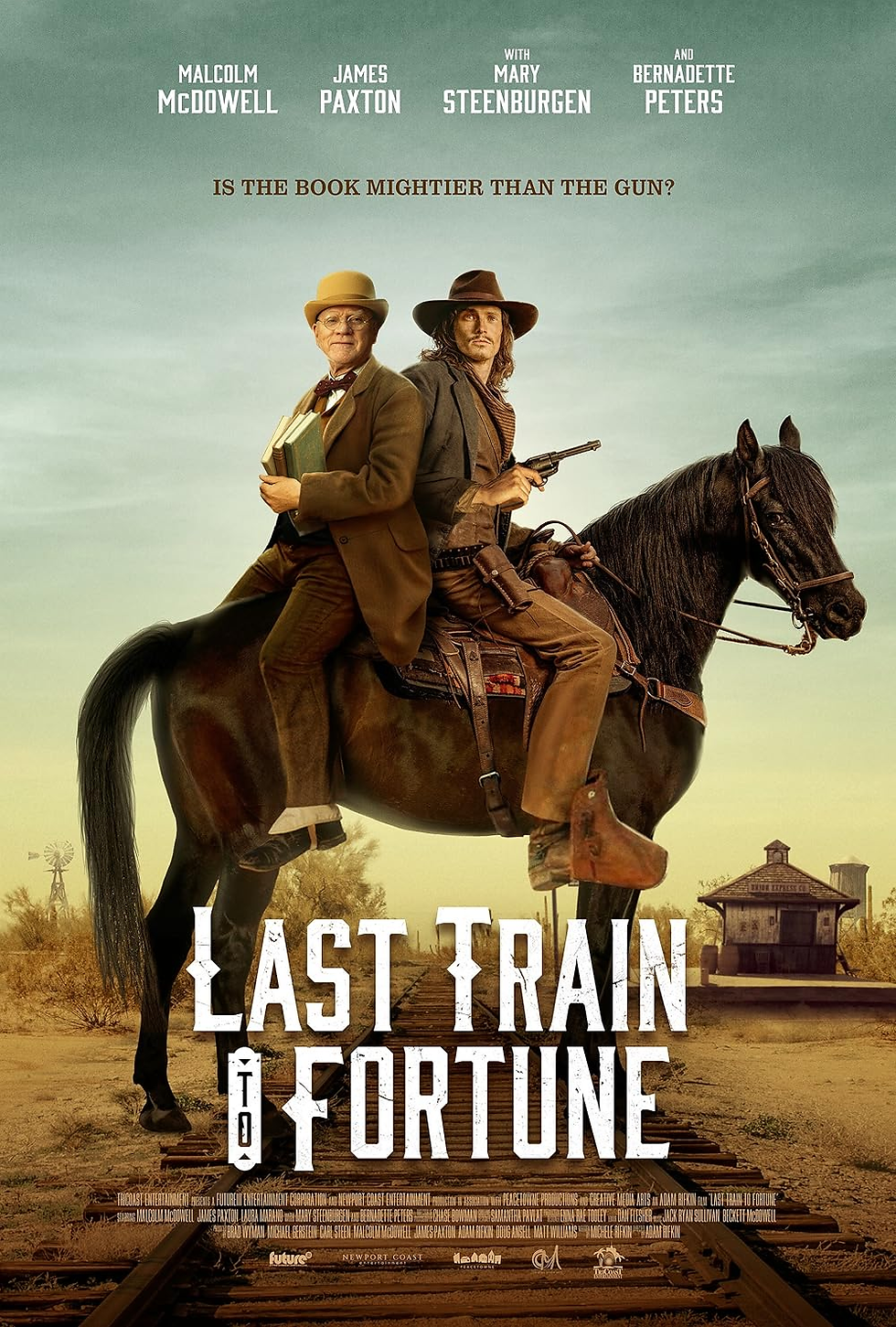
Few films demand quite the kind of patience, faith, and personal investment that Last Train to Fortune required of James Paxton. Attached to the project for years before cameras ever rolled, Paxton not only stepped into the boots of the wide-eyed Dooley but also took on a hands-on producing role to help shepherd the film from a long-dormant screenplay to the big screen. Shot against challenging desert landscapes and a condensed schedule, this wonderful film became as much a test of endurance as artistry. Yet for James, the journey has been a deeply personal one — tied to family history, creative legacy, and a lifelong admiration for Malcolm McDowell, who had once considered the project alongside Paxton’s late father, Bill Paxton. In this second conversation on Last Train to Fortune, James reflects on perseverance, artistic partnership, and why this timeless western may be arriving at precisely the right moment…
What were the biggest challenges in helping bring the project back to life?
Gosh, I think one of the biggest challenges for me was just staying the course and remaining patient in the development process. I was attached to the film for years and years before we even got to the filming stage. It was an incredible exercise in patience because I fell in love with the script and the story immediately, and of course, wanted to get right to work. I learned so much about the producing and development process through this film, and, ultimately, I’m a firm believer that if things are meant to be, they will come together eventually; you just have to lay siege to a project sometimes. I have found, though, that the ones worth making ironically often take the longest to get made and are the hardest to film. Last Train to Fortune feels like a very timeless film to me, the kind that could have existed in any time period in film history, and I think, funnily enough, that is why it took so long to put together.

Actor James Paxton.
It is rare these days that people set out to make a family-friendly western that has a positive and uplifting message. The other biggest challenge we encountered once we got to the actual filming portion of the project was logistically trying to shoot the hundred pages of the script in real Old West environments (like deep in the Lancaster desert) on a schedule that shrank from fifteen principal photography shoot days to only thirteen due to heavy rains. It was physically and mentally challenging as Malcolm McDowell and I had to contend with horseback riding chase sequences, both hot and wet weather conditions, and very, very dense and detailed dialogue.
I’m interested in not only hearing about how the project has evolved but also how your character, Dooley, was developed over the years since the original version.
As the director, Adam Rifkin mentioned in his interview with you, the script was originally written in 1987 by his mother, Michele Rifkin. For those who haven’t read that interview yet, Michele won a PBS screenwriting competition at the time for the original screenplay for Last Train to Fortune. There was movement in the early nineties, before I was born, to make the film with Lindsay Anderson at the helm to direct. Sadly, Lindsay passed away six months into development, and the film was shelved until 2018, when Adam Rifkin and producer Brad Wyman first approached me about potentially reviving it.
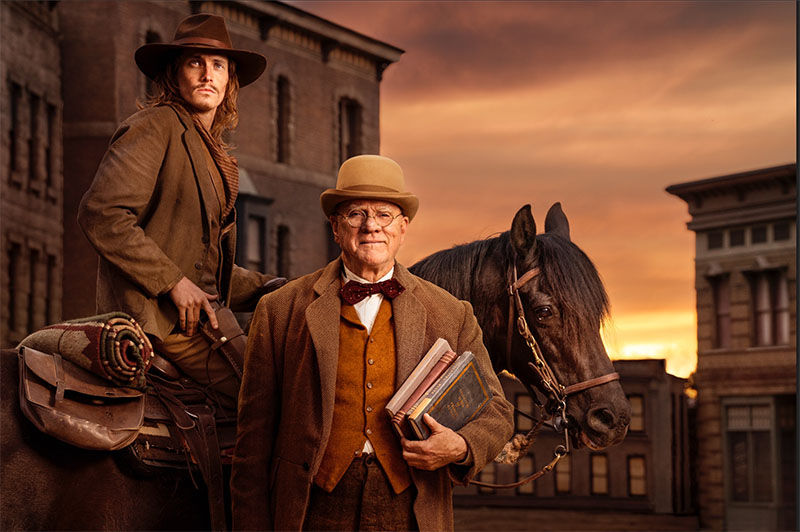
Never the twain shall meet. Dooley (James Paxton) and Cecil Peachtree (Malcolm McDowell) in LAST TRAIN TO FORTUNE.
It was always a bucket list item for Adam to get to make the film for his mother. Adam did a new pass on the original script, but changed hardly anything. The main difference between the characters of Dooley and Malcolm’s Cecil Peachtree from the original version to ours is that the two co-stars would have had much less of an age disparity between them. Malcolm would have been a lot younger at the time, and Dooley wouldn’t have been a young adult. This is why I truly believe each film has its own unique journey from screenplay to the screen, and how sometimes you can really see it is ultimately all for the best and at the service of a greater plan. Having the large age gap between Cecil and Dooley really helps their dynamic and the overall story. The messages of the film land harder. I think it was always meant to be this way, and the greatest confirmation of that I received came during filming when Michele (who was bedridden at the time and could not visit in person) face-timed Malcolm and I on the set between set-ups. She told us that when she saw us in our costumes, it was like seeing us “walk right out of her imagination, off of the page and into the real world.” That moment right there made it all worth it.
“This film is a real arrival for me — as an actor and as a producer. I proved something to myself on this film.”
— Jame Paxton
If you could describe both the main character’s arcs in one word, what would it be —and why?
I would say “kismet.” In this film, you have two people who meet by chance who both think that they know everything there is to know about life already. They finally realize that they both have something important to learn from each other, and vastly different pools of knowledge and experience to share with one another.

Was there a moment on set when you felt the project truly “clicked” for you as an actor?
This is a great question. Usually, for me, I finally feel like I’ve “got” a character right at the end of a shoot, which is maddening. However, with this film, because I had lived with the script for so many years and I knew the story inside and out, I knew my dialogue and the scenes back to front. Everything clicked immediately, the very first day on set with Malcolm. We were filming the first week on a green screen stage, before we headed out to actual outdoor locations, and we started with the campfire scenes. I knew the minute that Malcolm and I got rolling together that we had a special chemistry. Adam called cut and asked us if we had any idea how long the take was. We replied that we thought maybe eight minutes or so? Adam replied, “Nope, twenty-three minutes.” We had been going so long and didn’t even realize it because we were so deeply entrenched in the scene and the world of the film. It was almost like doing a two-man stage play.
I understand from speaking with Adam that Malcolm was involved with the original incarnation (the Anderson connection). I’m interested to hear more about this special relationship you built and how you developed your characters together.
Yes, Malcolm was originally involved in wanting to make the film in the early nineties, along with my father. Beyond a meeting or two, they never really got the development process in full swing before Lindsay Anderson passed away. Malcolm never forgot about the script and always kept it in the back of his mind for an opportunity to hopefully make it one day. I grew up in Ojai, California, and Malcolm was one of the only entertainment figures that my parents knew who lived up in Ojai before they moved there themselves in 1991. Malcolm witnessed me grow up, and when I turned eighteen, he started hiring me to watch his boys from time to time when they were young. He had been paying attention to my acting career for a number of years before he got the idea to tell Adam and Brad that they should try to make the film again, this time with me in the Dooley part.

Malcolm has always been an absolute inspiration and icon to me. I remember when he gave me a Criterion copy of his and Lindsay’s 1968 film If…. when I was a teenager, and it totally changed my life. He knows how to always fill his performances with so much charisma and mischief, and I grew up studying his work in not only that film but also O Lucky Man! and A Clockwork Orange. Working with him on Last Train to Fortune was like stepping into a masterclass every single day with a titan of the silver screen. I was soaking it all up like a sponge on steroids. The great thing is, Malcom and I really had many opportunities to read through the script together over the years before we started filming. So, we were able to hear it out loud together and workshop things to a degree that most co-stars don’t always get to ahead of time. Malcolm would help me make adjustments on set if he felt like I could do something slightly differently, and I relished those moments when he would share pieces of advice with me.
Did any other actor bring something unexpected to their roles and energize the film in particular ways?
Every actor brought something memorable to this film, as it was such a small cast to begin with. Most of the time, it’s just Malcolm and I on a horse — but I want to give a special shoutout with this question to Laura Marano. She plays Dooley’s love interest, Amanda, in the scenes set in Miss Lily’s Saloon, and Laura brought the most incredibly pure enthusiasm and energy not only in her onscreen performance, but also in her presence as a whole on the production. I totally fell in love with her as a person, and she has become one of my dearest friends in this industry. I am so happy she said yes to this film. There’s nobody who would have been better. From the moment she shrieks with joy seeing Dooley back in town, you can’t take your eyes off her. She puts a smile on my face every time I see the film. I also think that Mary Steenburgen and Bernadette Peters both inhabit their roles so fully that they add so much to the story.
What themes do you feel are the most important at the core of Last Train to Fortune, and why are they still important today?
Valuing education and cultivating an appreciation for reading are the most important themes at the core of this film’s story. The film is honestly a dedication to great teachers and mentors, who are so under-appreciated, especially in America, and who are some of the most important people in all of society. Michele Rifkin, the writer, was a teacher herself. The film does a great job of showing these themes and not preaching in any kind of way. It has a little bit of everything: action, comedy, drama, and a whole lot of heart. Cecil is able to convey to Dooley the value, importance, and joy of reading, whilst Dooley is able to show Cecil that you don’t have to be book-smart to be educated. They both teach each other valuable lessons and new perspectives. Additionally, books are being banned, censored, and burned more frequently than ever across this country. Education is being de-funded and is under attack right now by the current administration. It is a dire trajectory we are on as a nation right now, and I believe that for these unfortunate reasons, Last Train to Fortune is even more timely in its debut.
Character driven. LAST TRAIN TO FORTUNE shows off an array of archetypes that pop up on the journey.
How did the cast and crew support you in carrying forward something so deeply connected to your family?
Well, it was a family endeavor the whole way around. That’s one of the most beautiful aspects about this film. It is surrounded by so much love, with Adam’s mother having written it, Adam having directed, Brad Wyman having produced it (Adam’s longtime producing partner), my dad’s original involvement, and Malcolm bringing all three of his youngest sons into the mix, helping with the film. Malcolm’s son Beckett co-wrote the musical score for the film, and Finn and Seamus McDowell both had acting cameos. Not to mention Malcolm’s ex-wife, Mary Steenburgen, blessing the film with her wonderful performance as Miss Mabel. It was a beautiful energy that we all could feel every day on set — the kind of energy you feel when you know you are working on something worthy that has a special and storied history to it.
Now that the film is finally going out into the world, what does completing it mean to you on a personal level?
I genuinely do not know if I will even be able to find the words to describe what seeing it finally make its way out into the world will be like. I don’t think I have ever been closer to a film project in my whole career. I am so ready to “let go” a bit and see it take on a life of its own. I believe it will stand the test of time. It will be a whirlwind of emotions seeing it released, that’s for sure. I couldn’t be prouder. This film is a real arrival for me — as an actor and as a producer. I proved something to myself on this film. I’m here, and I’m ready, and I’m capable to handle any challenge.
Do you feel this project has changed your perspective on your own career and the types of stories you wish to tell moving forward?
This film definitely changed my perspective on my own career and what I would like to do with it. It marked the first time that I was involved in an extremely hands-on way as a producer. I knew the moment I finished reading the script that I would need to be involved on a deeper level than just as an actor alone on this. I knew I wanted to help do whatever I could do to see this film to the finish line. As an actor, you don’t always have much choice or say in what jobs you may or may not land, so to be able to step into producing specific projects that I believe in to the utmost degree is now a huge motivating factor for me. I championed Last Train to Fortune as a producer because of the fantastic writing paired with such an uplifting message — a message that could actually make a positive difference in the world. I want to make films that stand the test of time because they hold and carry important truths and wisdom. I will be looking for more of those going forward.
What do you hope audiences take away from watching the film?
I hope audiences find themselves transported back in time to 1873 and the Old West… I hope they fall in love with Dooley and Cecil Peachtree as much as I did, and I hope they find a movie that they enjoy and want to return to over the years. Lastly, I hope this film reminds people of the great teachers and mentors they hopefully had along the way…
You can follow Adam on Instagram. Last Train to Fortune is in theatres this Friday September 22nd, streaming and on demand.


Comments